

Somewhere in your ERP policy there is a number. It could be $250, or maybe it’s $1,000. Below that number, a discrepancy is routinely cleared, written off, or unpursued.
Resolving a $200 discrepancy can involve an accounts payable analyst pulling the purchase order and invoice, procurement checking the contract, the warehouse finding the delivery record, and someone reconstructing an email exchange from March before contacting the supplier. By the time the evidence has been assembled, reviewed, and acted on, the expected recovery may be smaller than the cost of the chase.
Policies like this accumulate over time as a business scales. The way companies absorb complexity is important IP, every business has its own realities and standard operating procedures bring sanity to that unique reality. Their creation and maintenance is a critical piece of a well functioning company. Exceptions and tolerances shouldn’t be mistaken for sloppy or lazy operations, there is logic behind where the line is drawn.
The problem is that it was drawn years ago, while the cost of looking has continued to fall.
What changed
You don’t need to follow AI research to run a company. However, a few developments from the past years matter for execs in traditional ERP centric finance. They change the economics beneath many existing policies.
Models have become magnitudes better at completing long, messy assignments that require planning and many steps. A few years ago, the tasks AI agents could reliably complete were measured in minutes. Today, the measurements extend into hours.
The systems surrounding the models have improved alongside them and may be even more impactful. A standalone AI model can reason over the information placed in front of it. When connected to company systems and given the ability to retrieve files, query the ERP, read contracts, check conclusions, and revise its work, the model becomes part of a much more capable operating system.
I like to think of this difference similarly to a new employee on the first morning and that same person three months later. When they are equipped with system access, operating context, and clear procedures for exceptions and reviews they are actually able to do the work. Modern model harnesses act as that machinery, they give the AI the hands to interact with the right surface area where the work actually happens.
The cost of running intelligent models has also fallen sharply in the last two months. Open source labs like DeepSeek and Moonshot are the clearest examples. Their newly released models crossed a capability curve that put them very near to OpenAI and Anthropic with open weights, meaning anyone can download, host, and adapt them while only paying the raw cost of running the chips and infrastructure around them.
The price matters in finance because an agent investigation can involve hundreds of reasoning steps. It may retrieve a contract, check the rate table, compare several invoices, notice an inconsistency, locate the delivery record, revise its conclusion, and verify the result. The cost of each step, multiplied across the entire investigation, determines which problems are economically worthwhile.
Cheaper intelligence creates new demand
Economist William Stanley Jevons observed that steam engines had become substantially more efficient while Britain’s total coal consumption continued to rise. Improved efficiency made steam powered work economical in more places, and the result was usage growth exceeding the savings by each engine.
Jevons paradox describes a pattern rather than a universal law. Lower prices sometimes produce straightforward savings. Other times they unlock enough new demand to increase consumption.
It’s a useful perspective on AI because most discussions initially focus on the jobs that could disappear as machines become capable of performing the work. In many cases the exact opposite has happened. Look at software engineering as an example, in 2025 people were talking about the category as solved and advising people to stop majoring in computer science. It’s in higher demand than ever in 2026. Finance leaders should examine the work that becomes economically viable once the cost of investigation falls instead of overfocusing on AI as a means of replacing people.
For a company that manufactures or moves physical goods, the shift in finance capacity when augmented by cheap intelligence has huge implications.
Physical businesses run on tolerances
Goods arrive late, quantities come up short, pallets get damaged, prices change during a contract, customers take deductions, and suppliers add surcharges. The purchase order, invoice, receipt, contract, and ERP record frequently disagree, which means someone has to investigate the truth.
Companies create buffers to operate within this complexity by establishing thresholds and tolerances for almost everything.
A company might investigate variances above a particular amount, review a sample of transactions, clear discrepancies below a threshold, or assume that a proportion of customer deductions is unrecoverable. The scale of exceptions means that not every contract term can receive systematic monitoring.
Tolerances generally exist for two reasons:
The cost of investigation exceeds the expected recovery. The economics are defined by the cost of an employee’s time, along with the coordination required across teams.
The company doesn’t have the required headcount and still needs to operate. Accounting is in the middle of a labor shortage and firms struggle to hire people to keep up. Under these conditions, exceptions and buffers become more problematic.
The situation is acknowledged in professional audit standards where sampling provides a rational way to test a subset of transactions to get a statistically sound judgement.
The reality is that employees leave, systems change, and the original reasoning behind a threshold becomes difficult to reconstruct. Operating procedure exception rules start logical then drift over time. They grow in number with a hidden impact that is hard to quantify in the bottom line of a complex business.
Examples of where financial leakage hides
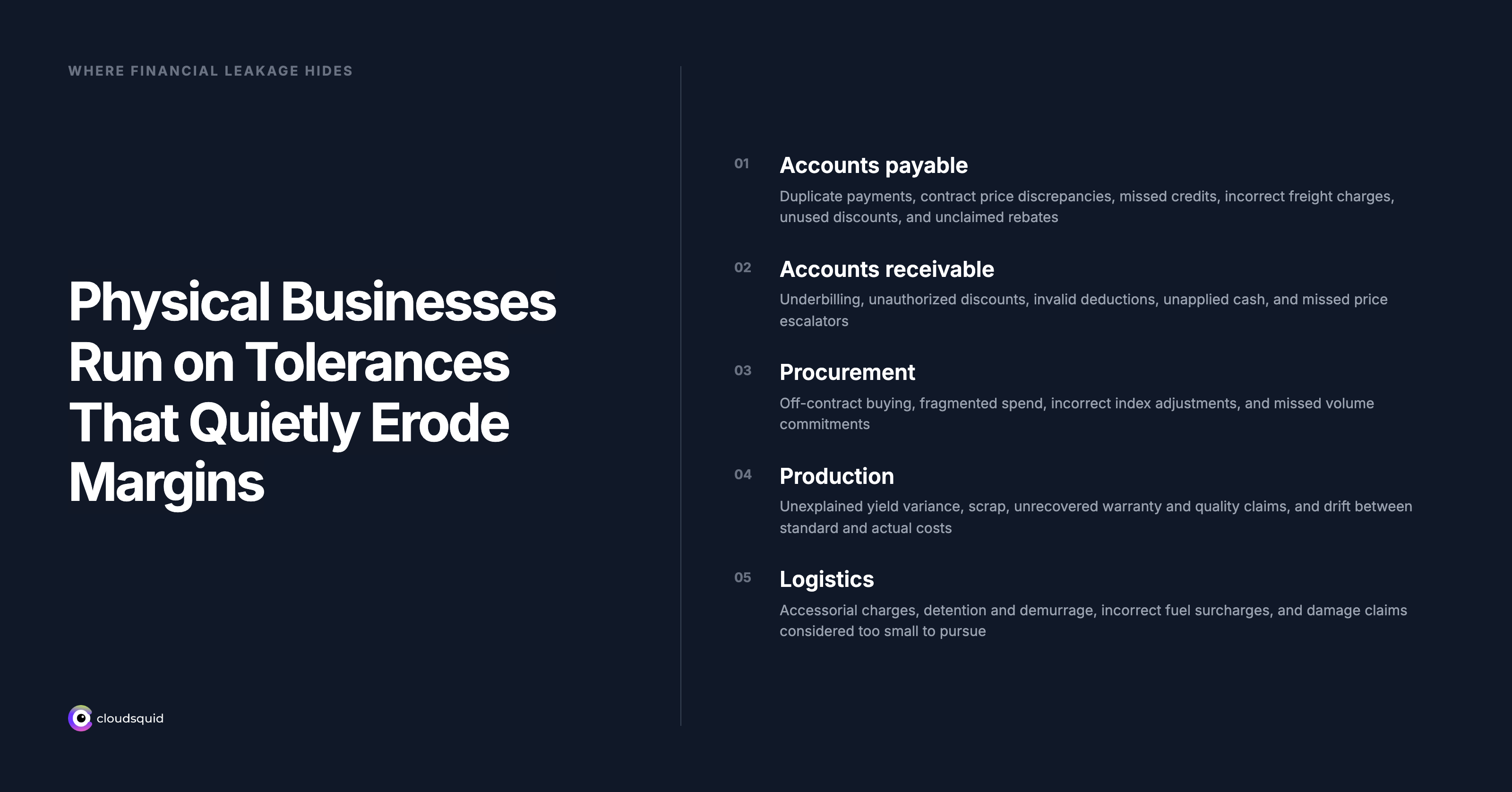
Each discrepancy can appear immaterial. Across thousands or millions of transactions, the value can become significant.
An alternative way to look at AI ROI
Most AI programs focus on headcount because payroll is visible and measurable. As we discussed the paradox of AI earlier, headcount replacement is too simplistic a way of understanding the potential for AI transformation. The opportunity cheap intelligence presents us is much larger than just payroll costs alone.
A company with a 5 percent operating margin may spend a year of leadership attention reducing back office costs while continuing to accept much more damaging recurring discrepancies across revenue, purchasing, inventory, and freight.
Even measuring the size of the problem used to require the same manual work that made the underlying discrepancies uneconomical to pursue. Cheaper intelligence also changes the cost of detecting problems because agents are perfectly suited for large scale data work.
Re-underwrite every tolerance
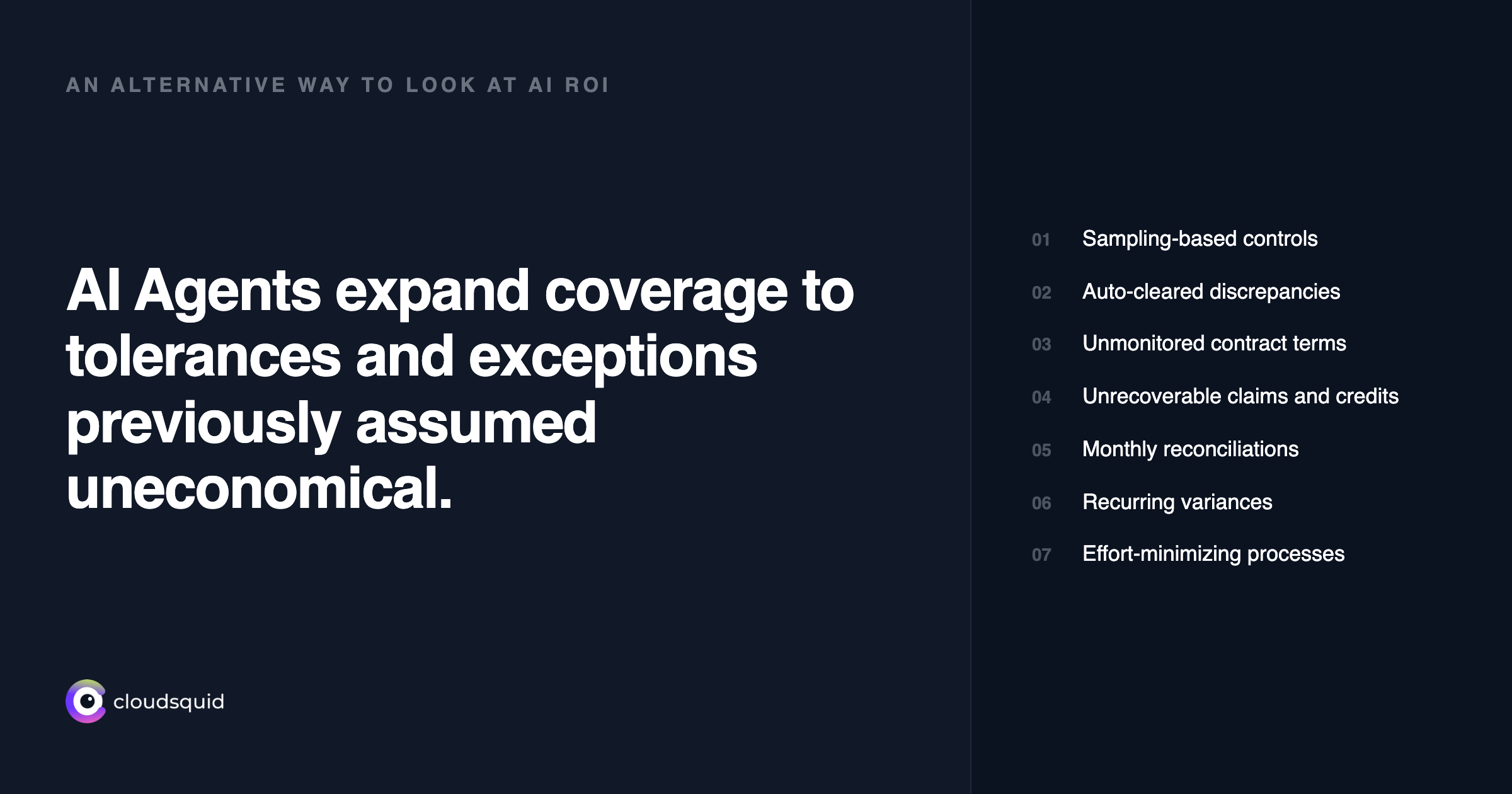
Finance teams can start by identifying the assumptions embedded in their current processes:
Controls that rely on sampling because full coverage was historically impractical
Discrepancies that are automatically cleared or written off
Contract terms that exist on paper without systematic monitoring
Claims, credits, rebates, and deductions classified as unrecoverable
Reconciliations performed monthly because continuous review required too much labor
Recurring variances described as normal without a cumulative value attached
Processes designed around minimizing administrative effort rather than protecting the value flowing through them
Some tolerances will remain sensible. Data will continue to be incomplete, disputes will still consume time, and certain discrepancies will remain too small or commercially unwise to pursue. In those cases, leadership will have validated the threshold deliberately instead of inheriting it.
Other tolerances will reveal an economic logic based on a cost of investigation that no longer exists in the world of AI agents.
The larger opportunity for finance
Headcount reduction will remain part of many AI business cases, but the value available through greater coverage may be considerably larger.
A finance team equipped with capable agents can examine more transactions, monitor more contractual obligations, resolve more deductions, pursue more claims, explain more variances, and identify recurring process failures. The team’s work gradually shifts from manually assembling evidence toward designing procedures, evaluating conclusions, resolving ambiguity, and changing the operating processes that created the exceptions.
As the execution becomes cheaper, judgment and accountability become the value of skilled operators.
AI will automate some finance work and change the shape of many roles. Its larger economic effect for now may come from problems that were previously too small, fragmented, frequent, or complicated to justify human attention.
Longstanding assumptions about the “cost of doing business” can be separated into unavoidable operational complexity and value that the company has simply stopped pursuing.
The question is how much margin is bleeding because looking used to cost more than finding? It’s time to update our assumptions on what’s possible.